The ei23 Dashboard / Supervisor
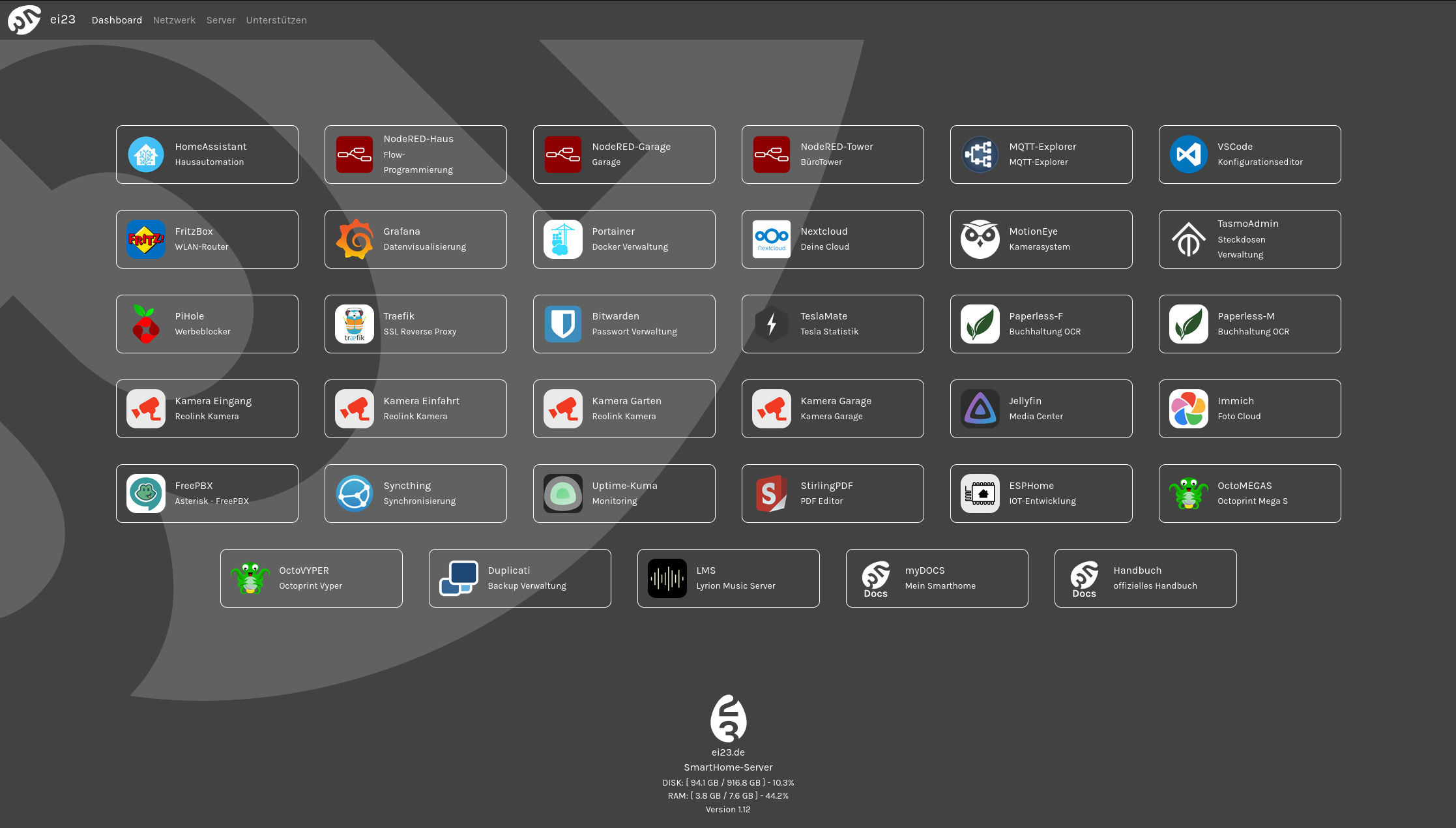
The ei23 Dashboard is more than just a display - it's a full server supervisor. It offers live monitoring, a program editor, template management, and server actions with real-time terminal output.
Overview
The dashboard consists of four main pages:
| Page | URL | Description |
|---|---|---|
| Dashboard | / | Program overview with icons |
| Network | /localnet | Network scanner |
| Server | /server | Server administration |
| Storage | /tree | Folder size analysis |
Dashboard Page (/)
The home page displays all active programs as tiles. Each tile is linked and can be opened with a click.
Server Page (/server)
The server page is the heart of the administration:
Live Resource Monitoring
At the top you can see real-time:
- CPU - Current CPU usage in percent
- RAM - Used and total memory
- Disk - Used and total disk space
The bars update automatically every 5 seconds.
Server Actions
With one click you can execute important server commands:
| Action | Description | Command |
|---|---|---|
| 📊 Docker Status | Shows all containers | docker ps -a |
| 🔄 Docker Compose | Starts/restarts all containers | ei23 dc |
| ⬆️ Docker Update | Updates all Docker images | ei23 du |
| 🧹 Cleanup | Deletes unused images | docker image prune -a -f |
| 📄 Build Docs | Builds the documentation | ei23 docs |
| 🏠 HA Addons | Updates Home Assistant addons | ei23 ha-addons |
| 📦 APT Update | Updates system packages | apt-get update && upgrade |
| 🔧 ei23 Update | Updates only the ei23 script | ei23 ei23update |
| 🚀 Full Update | Complete system update | ei23 update |
| ⚡ Reboot | Restarts the server | sudo reboot |
Terminal Output
After starting an action, a terminal window opens with real-time output:
- Auto-Scroll can be toggled on/off
- Error lines are highlighted in red
- Successful lines are highlighted in green
- Warnings are highlighted in cyan
Session Badges
Running actions show an animated dot ● next to the button. After completion, ✓ (success) or ✗ (error) is briefly displayed.
Actions continue running
Server actions continue running even if you leave the page. After returning, you'll see the current status.
Docker Container
All containers from docker-compose.yml are displayed as cards:
| Status | Color | Meaning |
|---|---|---|
| HTTP Available | 🟢 Green | Web interface accessible |
| Host Mode | 🟣 Purple | Host network mode |
| Port Active | 🔵 Blue | Port is open |
| Internal | ⚫ Gray | Internal only |
Click "Scan Containers" to update the status.
Add Docker Programs
New Feature
Programs can now be added directly from the dashboard!
The template panel is collapsible (click on the heading):
- Expand the panel
- All available templates are displayed
- Already installed templates are grayed out
- Click "+ Add" to append a template
- Then run "Docker Compose" to start the container
Note
Duplicates and port conflicts can cause errors. Check the docker-compose.yml manually if needed.
Edit Dashboard Links
The program editor offers full control over the dashboard:
Add Programs
- Click "+ New"
- Fill in the fields:
- Name* (required)
- Title (subtitle)
- Port (e.g. 8080)
- Icon (e.g.
img/nodered.png) - Custom URL (optional, overrides port)
- Active (visible in dashboard)
- Click "Add"
- Don't forget to "Save"!
Edit Programs
- Active/Inactive: Toggle switch
- Fields: Edit directly in the form
- Sort: Drag & Drop with ⋮⋮ handle
- Delete: ✕ button (with confirmation)
Import Templates
Click "Templates" to add missing programs from programs_templates.json. These are imported as inactive.
Explanation of programs.json
The file is located at /home/[user]/ei23-docker/volumes/ei23/web/static/programs.json
{"programs": [
{"active": true,    "port": "",     "custom_url": "http://10.1.1.11:1880",  "name": "NodeRED",          "title": "Garage",              "img": "img/nodered.png"},
{"active": true,    "port": "4004", "custom_url": "",                       "name": "MQTT-Explorer",    "title": "MQTT-Explorer",       "img": "img/mqtt-explorer.png"},
{"active": false,   "port": "",     "custom_url": "http://10.1.1.12",       "name": "Camera Garden",    "title": "Nice Garden",         "img": "img/camera.png"},
{"active": true,    "port": "3000", "custom_url": "",                       "name": "Grafana",          "title": "Data Visualization",  "img": "img/grafana.png"}
]}
"http://10.1.1.11:1880"is a Custom URL - can also be an external address- Without Custom URL, the port is combined with the IP address (e.g.
http://10.1.1.2:4004) "active": falsehides the entry- The last element must not have a comma at the end
Network Page (/localnet)
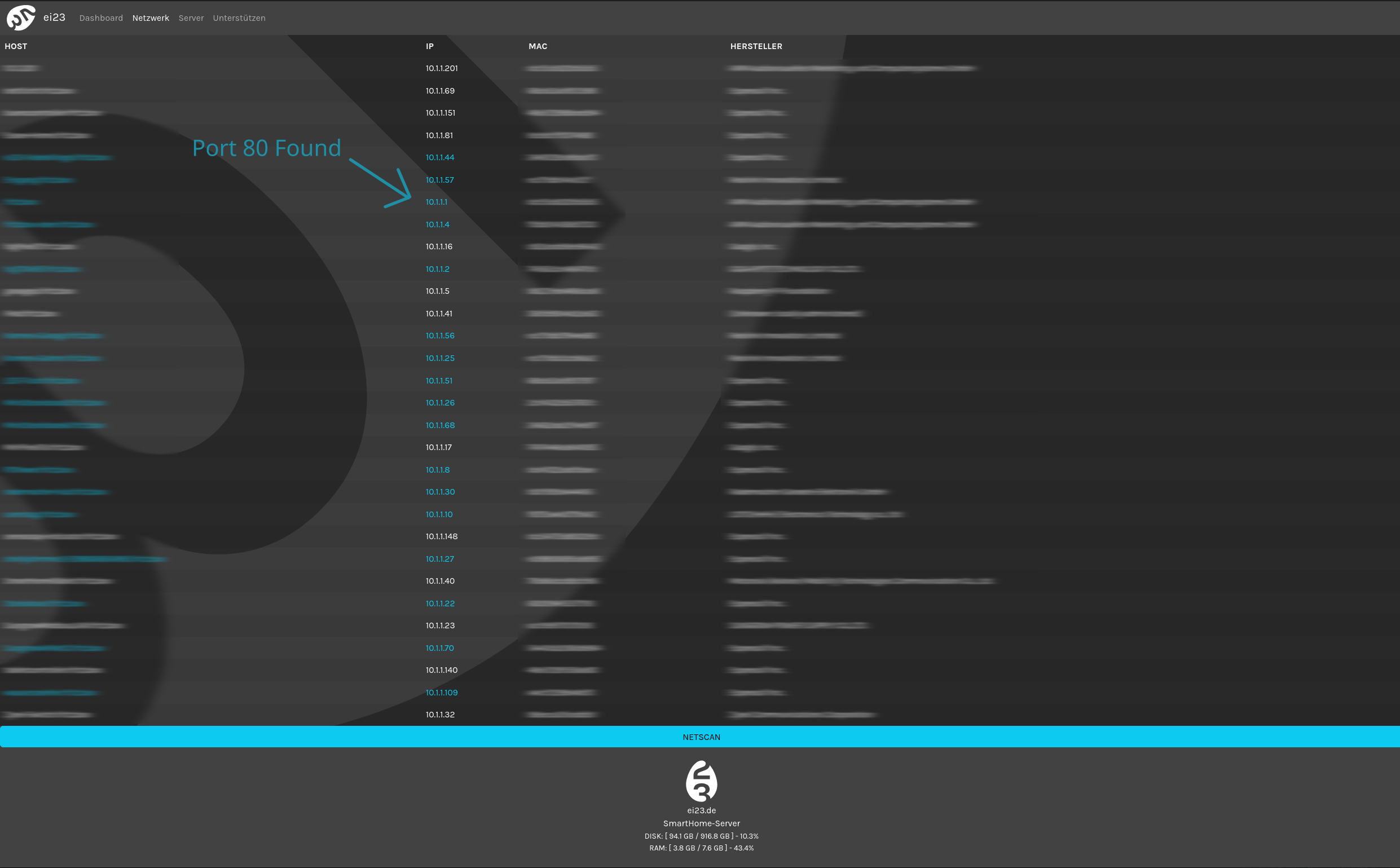
The network scanner shows all devices on the local network:
- Hostname - Device name (if resolvable)
- IP Address - Directly linked when web interface detected
- MAC Address - Hardware address
- Vendor - Device manufacturer
HTTP Detection
When a device has port 80 open, it's highlighted in blue and the IP is directly linked.
Click "Scan" to rescan the network.
Storage Page (/tree)
Shows disk usage by folders - useful for finding large directories.
Configuration
Change Port
Create/Edit /home/[user]/ei23-docker/volumes/ei23/config.ini:
Then restart the supervisor:
Check Status
Notes
- The dashboard runs as a Python-Flask server with Waitress
- The service starts automatically on boot (
ei23.service) - The dashboard is accessible on port 80 (configurable)
- Program icons are located at
/home/[user]/ei23-docker/volumes/ei23/web/static/img/ - Custom icons: 128x128 PNG with transparent background